I've been thinking about what makes me happiest:
Outdoor adventures, certainly.
Reading books.
Teaching classes.
Playing board games.
Talking to interesting people.
What do these things have in common?
Learning.
So, let's take outdoor adventures. I really enjoy them all, but they really sing to my soul when I go new places or learn new skills.
Or let's take board games. One wouldn't think they're a learning experience (and sometimes they're not), but, again, they're at their best when I discover new strategies or ways of seeing them.
Or, crossword puzzles, which I've decided I love. I learn new words, new associations, new ways of thinking.
I hope to dedicate my weekly blog to stuff I've learned. Maybe a daily Facebook post on what I've learned too.
Sunday, July 15, 2012

Sunday, July 8, 2012
Institutions Are Destiny
With the 4th of July this past week, it seems appropriate to review the hottest academic book on politics of the past year, "Why Nations Fail."
The book is written for a general audience, and if you're feeling smart and ambitious, it is well worth reading. It aims to be the "Guns, Germs, and Steel" of the social sciences. The thesis in "Guns, Germs, and Steel" is that Geography/Climate is Destiny. Civilization arose and thrived where geography and climate endowed people with the most nutritious and easily cultivatable food. Those locations created dynamic human societies that gave rise to complex socio-political institutions, sophisticated languages, inventions, and so forth.
"Why Nations Fail" addresses not the rise of civilization but rather the success and failure of modern nation-states. Why, for example, has the United States succeeded so much better than Mexico? The answer: Institutions are Destiny. Where inclusive, democratic-style political institutions are put in place early on, they produce economic progress and all good things, like rapid technological advances. American colonists got it right; Spanish colonists did not. All else flows from this. (Though, if forced to pick a single moment on which the fulcrum of history swings, "Why Nations Fail" would choose the 1688 Glorious Revolution in England rather than the founding of America.)
Most people I know already believe that the founding of the United States and its associated institutions (Declaration of Independence and the Constitution) are in fact responsible for the great things that have happened in this country. But this book only occasionally looks at the United States. It gazes more frequently at examples of poor political institutions, probably because there are many more examples to choose from. In recounting all the political institutions you've never heard of (from long-gone African kingdoms to colonial patterns in Central America), the book takes readers on a fascinating journey.
The book excels at drawing connections between those institutions and good economic outcomes, like growth and innovation. I've always believed that institutions are destiny. This book illustrates the ways in which institutions shape social and economic activity by using broad patterns and, at times, careful historical process-tracing. The case of the Southern United States is a fascinating example. The South failed to get its institutions right after the Civil War and thus descended into another 100-plus years of less robust growth and economic progress than the rest of the United States.
What does the book not do? It does not explain how these institutions arise, though at times it wants to. It also does not give enough credit to the importance of values and ideas. It might also underplay the importance of human capital (i.e., education). Wordiness is a problem; many chapters repeat main points far too frequently. But, all in all, a fabulous book and amazing achievement.
The book is written for a general audience, and if you're feeling smart and ambitious, it is well worth reading. It aims to be the "Guns, Germs, and Steel" of the social sciences. The thesis in "Guns, Germs, and Steel" is that Geography/Climate is Destiny. Civilization arose and thrived where geography and climate endowed people with the most nutritious and easily cultivatable food. Those locations created dynamic human societies that gave rise to complex socio-political institutions, sophisticated languages, inventions, and so forth.
"Why Nations Fail" addresses not the rise of civilization but rather the success and failure of modern nation-states. Why, for example, has the United States succeeded so much better than Mexico? The answer: Institutions are Destiny. Where inclusive, democratic-style political institutions are put in place early on, they produce economic progress and all good things, like rapid technological advances. American colonists got it right; Spanish colonists did not. All else flows from this. (Though, if forced to pick a single moment on which the fulcrum of history swings, "Why Nations Fail" would choose the 1688 Glorious Revolution in England rather than the founding of America.)
Most people I know already believe that the founding of the United States and its associated institutions (Declaration of Independence and the Constitution) are in fact responsible for the great things that have happened in this country. But this book only occasionally looks at the United States. It gazes more frequently at examples of poor political institutions, probably because there are many more examples to choose from. In recounting all the political institutions you've never heard of (from long-gone African kingdoms to colonial patterns in Central America), the book takes readers on a fascinating journey.
The book excels at drawing connections between those institutions and good economic outcomes, like growth and innovation. I've always believed that institutions are destiny. This book illustrates the ways in which institutions shape social and economic activity by using broad patterns and, at times, careful historical process-tracing. The case of the Southern United States is a fascinating example. The South failed to get its institutions right after the Civil War and thus descended into another 100-plus years of less robust growth and economic progress than the rest of the United States.
What does the book not do? It does not explain how these institutions arise, though at times it wants to. It also does not give enough credit to the importance of values and ideas. It might also underplay the importance of human capital (i.e., education). Wordiness is a problem; many chapters repeat main points far too frequently. But, all in all, a fabulous book and amazing achievement.
Sunday, July 1, 2012
Adventure Books
I've always thought about reading adventure books, but never have. "Into Thin Air" is the one that people seem to know and talk about the most.
Then Ellen read a youth book in her young adult literature class about Shackleton's South Pole adventure that was tremendous, "Shipwreck at the Bottom of the World." I loved it. So, when I started thinking about fun summer reading, I looked around for the best.
I found this sweet list by National Geographic: http://www.nationalgeographic.com/adventure/0404/adventure_books.html
The 100 best adventure books of all time. Into Thin Air is in the top 10, but was checked out from my public library. So I went with "Annapurna," the story of the first summit of a 26,000-foot peak, in 1950. It's pretty amazing. I also read "No Way Down," which is not on the list but is about a deadly day on K2, where 11 of 24 climbers died. It is excellent. So, I've found a new genre I love. I gave the K2 book to Nathan, who is also really enjoying it.
"Annapurna" deserves its place on the list of classics because the writing is really beautiful (translated from French). He is an adventurer with a gift for describing the scenery and the happenings around him. It also deserves a place because the book offers perhaps the best statements I've seen on what motivates folks like him. He lost all fingers and toes to frostbite and the journey down the mountain was agony. Yet he explains so well what drove him and he feels the cost was worth it. This isn't eloquent, but it boils down to: "It's just who I am and I have to be true to myself." From these books, I learn that great explorers have some serious egos and aren't the friendliest folks around or the easiest to get along with.
Then Ellen read a youth book in her young adult literature class about Shackleton's South Pole adventure that was tremendous, "Shipwreck at the Bottom of the World." I loved it. So, when I started thinking about fun summer reading, I looked around for the best.
I found this sweet list by National Geographic: http://www.nationalgeographic.com/adventure/0404/adventure_books.html
The 100 best adventure books of all time. Into Thin Air is in the top 10, but was checked out from my public library. So I went with "Annapurna," the story of the first summit of a 26,000-foot peak, in 1950. It's pretty amazing. I also read "No Way Down," which is not on the list but is about a deadly day on K2, where 11 of 24 climbers died. It is excellent. So, I've found a new genre I love. I gave the K2 book to Nathan, who is also really enjoying it.
"Annapurna" deserves its place on the list of classics because the writing is really beautiful (translated from French). He is an adventurer with a gift for describing the scenery and the happenings around him. It also deserves a place because the book offers perhaps the best statements I've seen on what motivates folks like him. He lost all fingers and toes to frostbite and the journey down the mountain was agony. Yet he explains so well what drove him and he feels the cost was worth it. This isn't eloquent, but it boils down to: "It's just who I am and I have to be true to myself." From these books, I learn that great explorers have some serious egos and aren't the friendliest folks around or the easiest to get along with.
Monday, June 18, 2012
The death of the university?
Breathless commentators are giddy foreseeing the future of higher education as a series of online courses tailored to fit student needs. The university, they proclaim, is virtually dead http://www.washingtonpost.com/blogs/college-inc/post/guest-post-an-arab-spring-of-free-online-higher-education/2012/02/03/gIQAXiOFnQ_blog.html
We need only wait, say they, to see if online content resembles an Amazon model or an Ebay model.
It's amazing that supposedly smart people get away with such balderdash.
First, a bit of history. When I was interviewing for jobs 15 years ago, I sat on an airplane next to a guy who was recording the world's best professors at top universities. He wondered why I was even bothering with a career that would soon die because everyone would pay to watch videos of the best teachers. Hmmmm. Well, I'm still here, and I see "great lecture" courses offered for extremely steep discounts.
So, now the trend is toward offering videos or "courses" online for free for low charge. Perhaps this should be labeled the "Wikipedia" model. I've looked at a couple of these, including MIT's "every course is online" project and the "Kahn Academy." I'm deeply unimpressed. The video lectures seem well-done, but there are two fundamental problems.
1-Learning requires interactivity. Watching a video is very different from interacting with a faculty member and fellow students in class. These videos perpetuate the worst possible teaching techniques: lecturing to a disconnected audience. That's not what higher education is, and online videos are free or cheap because that's their basic value: close to zero. The really valuable resource is the time of smart people, both students and faculty, and that's a very limited resource.
2-The proliferation of videos will lead to the same problem Wikipedia faces: low information about the quality of an article. When I read a Wikipedia article, I learn stuff. But I am always amazed at the level of contestation going on about virtually every article. Monitors regularly point to unsubstantiated or disputed "facts" or interpretations and most discussions about the problems seem to bog down in interminable debates. One can never be sure about the quality of the information. And, for topics, I know something about, Wikipedia barely grazes the surface, so the safe assumption is that the information is fairly low quality. Something can be reasonably fair and correct, by the way, and still be low-quality.
So, there you go: If you want lectures with low levels of interaction and uncertain quality, nearly free online education looks very promising indeed. For something of quality, I expect folks will need to pay.
We need only wait, say they, to see if online content resembles an Amazon model or an Ebay model.
It's amazing that supposedly smart people get away with such balderdash.
First, a bit of history. When I was interviewing for jobs 15 years ago, I sat on an airplane next to a guy who was recording the world's best professors at top universities. He wondered why I was even bothering with a career that would soon die because everyone would pay to watch videos of the best teachers. Hmmmm. Well, I'm still here, and I see "great lecture" courses offered for extremely steep discounts.
So, now the trend is toward offering videos or "courses" online for free for low charge. Perhaps this should be labeled the "Wikipedia" model. I've looked at a couple of these, including MIT's "every course is online" project and the "Kahn Academy." I'm deeply unimpressed. The video lectures seem well-done, but there are two fundamental problems.
1-Learning requires interactivity. Watching a video is very different from interacting with a faculty member and fellow students in class. These videos perpetuate the worst possible teaching techniques: lecturing to a disconnected audience. That's not what higher education is, and online videos are free or cheap because that's their basic value: close to zero. The really valuable resource is the time of smart people, both students and faculty, and that's a very limited resource.
2-The proliferation of videos will lead to the same problem Wikipedia faces: low information about the quality of an article. When I read a Wikipedia article, I learn stuff. But I am always amazed at the level of contestation going on about virtually every article. Monitors regularly point to unsubstantiated or disputed "facts" or interpretations and most discussions about the problems seem to bog down in interminable debates. One can never be sure about the quality of the information. And, for topics, I know something about, Wikipedia barely grazes the surface, so the safe assumption is that the information is fairly low quality. Something can be reasonably fair and correct, by the way, and still be low-quality.
So, there you go: If you want lectures with low levels of interaction and uncertain quality, nearly free online education looks very promising indeed. For something of quality, I expect folks will need to pay.
Sunday, April 22, 2012
NYC and Other Great Cities
I'm going to New York City this week. I have brief conference there on Friday, but I'm going early and staying late. I'm taking Leah with me. It's her 5th/6th grade trip. All my kids get one business trip with me when they're that age. I took Adrienne to Boston, Sammie to San Diego, Nathan to Chicago, and now Leah to NYC. It's super-cute how excited she is! She mostly wants to go to American Girl, so we have lunch reservations, and to the zoo. More on our trip next week, hopefully with photos!
This makes me reflect on my favorite American cities to visit. They are probably, in order:
1. Boston
2. NYC
3. Washington
4. Chicago
5. San Francisco
6. Seattle
7. San Diego
8. Philadelphia
I don't think anywhere else makes the list of recommended cities. I'm on the fence about New Orleans. I guess I'm going again in August. We'll see how it's changed since Katrina. It's worth a visit, probably, and I think I'm talking myself into putting it on the list. But it also has large downsides, such as terrible transportation and, of course, the sleaze.
There is no city I would really try to avoid, but nothing much excites me about Atlanta, Dallas, Los Angeles, Portland, Denver, Minneapolis or Detroit. They have their high points for sure, but perhaps not enough for a real recommendation. Nevertheless, the Henry Ford museum and village in Detroit gets a shout out for one of the very coolest historical presentations in America, probably ahead of Williamsburg and Nauvoo.
I just checked the list of largest metropolitan areas in the US. Of the top 10, I only haven't been to Houston and Miami. I feel no loss.
Of the next ten, I haven't been to Phoenix, Tampa or Baltimore. I sort of feel an urge for Baltimore, if only to visit the Orioles' stadium, which looks really cool. There must be other interesting things in Baltimore. And I guess I can't really claim to have seen St. Louis much; just drove through it once.I would like to see it too.
Sunday, April 15, 2012
On Ghastly Gashes
Sammie put a ghastly gash in her leg just below her knee last Sunday evening, Easter Sunday. She has become a minor celebrity because she posted the gruesome photo on Facebook and it hasbasically gone viral, in a limited way. People like her friend's brother's friend think it cool enough to put on their phones and everyone in church today wanted to see it or wanted a copy. It is really, really grotesque. She slid into a sprinkler head while we were playing Pickle with a frisbee. I feel terrible because I had encouraged her to slide. The sprinkler head in question is plastic, and maybe 1/16 of an inch above the surface of the grass. But it acted like a deep razor and sliced her leg open badly for a very long distance. I'm not sure the distance, but several inches.
We took her to the emergency room and the doctor took one look at it and called the orthopedic surgeon at a different hospital and ordered her transferred. It was so beastly that the ambulance guys who came to get her were snapping photos of it, for future trauma training or something, or maybe just because it was so cool. The anasthesiologist, who looked about 55 to 60 years old, said he had never seen anything like it.
I did not get a good look at it until we were in the emergency room when they cut off her pants. I only caught a quick glimpse, but nearly fainted. I felt very lightheaded, had to move out into the hallway and sit down and put my head between my legs. They gave me some Sprite and I started to feel a bit better. Luckily, Charlie was with us, and could help out. I'm a mess with blood and injuries. I would be the world's worst soldier, always passed out by the sickening sights. I sometimes wonder what I would have done if drafted in a major war. Hopefully they would have figured it out and given me a desk job somewhere clerking for someone.
Anyway, Sammie thinks it's awesome, and so, apparently, does the rest of the world. I'm happy for them. It might be worse for me since it's my daughter and I feel responsible for telling her to slide. I'm not sure I'll ever look at the photo.
I'm just grateful that we live in an age where she can receive excellent care from skilled doctors and get pumped full of antibiotics to prevent infection. The surgical nurses said they were picking a lot of grass out of the wound and could put their hands halfway down her shin inside the skin because it had ripped the muscle away from the bone. Crazy.
I'm grateful for God's blessings in the face of such awful injuries. Sammie came home from the hospital Wednesday and spent the next three days fishing with us. We had a lot of fun and she is a wonderful girl!
Monday, April 2, 2012
Violence in Film
With the release of Hunger Games, violence in the media is a hot topic of discussion again. Let it first be known that I love the Hunger Games series; it is perhaps my second-favorite fantasy/sci fi series after LOTR. Many do not like the third book, arguing that it gets away from the essential story. I disagree. But let's leave that for another day. The question now is: What's a concerned parent to do with something like the violence in The Hunger Games film?
I have not yet seen the movie, but I've been reading a lot about it. I did recently watch another very violent movie: The Dark Knight. Sammie has been telling me for years to watch it; for a couple of years it was her favorite movie and basically the only movie she would watch. She generally doesn't like movies. I recently let Nathan watch it as well. I recall my students urging me to see it from the moment it appeared and hear it frequently named among LDS students as a favorite.
Well, I finally saw it. The movie has a lot to recommend it, including outstanding acting and pacing. It even, surprisingly, deals with great themes and interesting ideas, which I think are both essential for great movies and books. The choices faced by the District Attorney in Gotham capture nicely the sorts of dilemmas facing politicians in, say, Mexico where they get blamed for fostering violence when they go after powerful outlaw elements like the drug cartels.
Yet, at the end of the day, I'm going to trash our copy of the movie (given to us, probably; we don't generally pay for movies) and have talked to my kids about not watching it again. I have two fundamental objections: 1-It portrays the details of violence, and talk about violence, far too explicitly and unnecessarily; and 2-More disturbingly, it portrays an extraordinarily bleak picture of human nature.
I read a story in the D.News where they were interviewing a psychology professor at BYU who studies media and violence. He was arguing that context is king: If violence is portrayed in a disapproving fashion, as in Hunger Games, it is far less harmful than if it is portrayed in approving light. I think, upon reflection, that this is exactly what's wrong with Dark Knight. It's not just that it's violent; it's that the notion of good and evil disappears.
I very much admire complexity, but I detest relativism. Picking one's way through complex choices in a murky world is essential; striving to do one's best in this process is admirable. In Dark Knight, virtually no one even cares enough to even try to sort through the morality of it all. There are a couple of glimpses of people caring about morality and making moral choices. But they are generally few and far between. They are generally amoral individuals driven only by passion.
Consider for a moment another fairly violent film: Harry Potter VII (1 or 2, take your choice). Both Potter and Knight get rated a 7 on the violence scale by parental guidance website "Kids In Mind." But think about Voldemort's compatriots in comparison to the Joker's. Voldemort's people sometimes demonstrate reluctance or even defiance when asked to engage in some great evil. The Joker's henchmen, in contrast, think nothing of killing a friend in the middle of a conversation.
We live in a violent world; I don't mind seeing some on screen. But we also live in a world where people have strong moral views and where human nature has a lot of good in it. To remove that entirely from the picture is a real tragedy. We have too much of cynicism in the world; it is the reinforcement of cynicism and the absence of virtue that I worry about, more than violence, in these films.
To its credit, the website commonsensemedia has started to take this viewpoint into account. It now has ratings for positive messages and role models, not just level of violence. And it seems to take account of such things in its ratings. This is the right move, and it's a good place for parents and teens to go to begin to get advice and information about these sorts of things.
Sunday, March 18, 2012
TV
For some reason, watching movies seems a daunting task to me. They're too long. I can never finish one. Everyone is always needing to be run somewhere, even late at night, or helped with something.
Also, TV shows are now widely available without commercials on Amazon and Netflix, and we subscribe to both. So, I've done something I figured I would never do and started watching TV shows again.
Ellen is a HUGE fan of Downtown Abbey and got me watching them. I've seen 5 episodes. I liked the first one quite a bit, but they're sort of going downhill for me. I like some of the relationships, like the one between the older women. Maggie Smith is absolutely spectacular. She had a line about foreigners dying in the fourth episode that still has me chuckling whenever I think of it. And I like most of the male characters. But the sisters and mother seem faintly ridiculous. While relationships between many of the characters develop naturally, the sisters' relationships--both with each other and with others outside the family--veer off in wildly unpredictable directions that seem forced and artificial. And I never really like characters who are pure spite and evilness, like those two servants. A little character complexity would be welcome. I'll probably stick with it for a while longer, but may not last.
My favorite show at the moment is Sherlock, also produced by Masterpiece Theatre. It's interesting the BBC has had two huge hits here in the past two years. Sherlock only had 3 episodes its first season but has a bunch scheduled for this season, beginning in May. I'm pumped. It's witty, interesting, complex, and well-paced. I generally like well-plotted murder-mysteries and also like excellent dialogue, and this show does them both very well.
In a BBC mood, I tried the first episode of Dr. Who last night, the 2005 version. It was lots of fun as well. Dr. Who has had a couple of different incarnations on the BBC as I understand it, and is a bit like Star Trek in the sense that many are die-hard fans of the classic version. This 2005-present version apparently has lots of fans as well, and I can see why. It's entertaining, lively, quirky, and has some intriguing characters.
Finally, because book reading has ground to a halt with the busy-ness of the semester, I've decided to try some documentaries. Jazz, by Ken Burns, is great. The story of jazz is the story of America. And Planet Earth, the top-rated TV show of all time, is also pretty mesmerizing, I agree.
Sunday, March 11, 2012
Evaluating Teachers
Whenever the question of merit pay for teachers arises, I hear teachers claiming that it is difficult to evaluate their work. I don't agree. To clarify, I think it is generally difficult to evaluate intellectual or creative work, but it is probably no more difficult to judge teaching than any other intangible work. I understand that standardized tests should not be the only measure, but it should be part of the equation.
I think I've read where New York does about 50 percent standardized tests and 50 percent evaluation from the principal. That seems a reasonable formula. Some might argue that principal evaluations are subjective. The way to solve that problem is to have more people involved in the evaluation.
At universities, we rely on committees to evaluate each other's teaching. Why can't secondary and elementary schools do that? The principal would select a committee of five or so of the best teachers and they spend time evaluating the teaching of others as well as the teaching of those on the committee (where the person being evaluated of course does not participate).
In many cases, it's not that difficult to identify better and worse teaching. Let's take my son's English teacher last year and this year. Both taught Shakespeare. The one last year had them listen to a recording. The one this year draws names out of a hat at the first of class and allows those students to choose a part. Each student then reads his/her part with others following along. They stop regularly to discuss what is happening. Then they watch the portion of a film that corresponds to the section they just read. Which technique is superior? That's easy. Moreover, adopting the second technique is EASY. Without merit pay, teachers can be extraordinarily lazy, painfully so. I wonder which teacher enjoys her job more? Wouldn't an evaluation and pay for better teaching make everyone's life easier and not be that difficult to implement?
Generally, I'm an underdog kind of guy, and that should potentially extend to unions. But the more I learn about teaching unions--and that's the only one I know anything about, to be sure--the more dismayed I become. Unions do seem to be the enemy of learning and improvement, to the extent that they oppose evaluations and merit pay.
Sunday, February 19, 2012
Winter Adventures: Silver Lake

 I definitely have winter adventures, but haven't blogged much about them. Many of them are at night, snowshoeing all over creation. Others are in adverse conditions, making picture-taking difficult. We were soaked to the bone on one memorable adventure up Maple Mountain. Taking pictures was not a good option. But this past Saturday, we had a glorious day AND I remembered my camera. We skied up the road from Tibble Fork Reservoir about 3.5 miles to Silver Lake Flat Reservoir (no water in it) pictured here. We intended to hike to Silver Lake, about 2 miles farther on, at the base of that mountain in the middle of the first photo, White Baldy. The mountain is part of the boundary between American Fork Canyon and Little Cottonwood Canyon.
 This next photo is a look back at Timp from Silver Lake Flat.


It was an AMAZING day! I'm not sure the temperature, but I was very warm. Probably around 30 degrees, but we were working hard! Lots of sun. I should have had my hat. I definitely wore sunscreen.
Surrounded by beauty on the way to Silver Lake. I had to turn around to get back to Nathan's basketball game and so didn't make it to the lake. Still, my grand total miles were about 11, with a 1500 foot elevation gain. I did it in four hours flat. Theo came along but didn't hold still long enough to be in any photo.
Heading up to Silver Lake, about the spot where I turned around. It was 3 hours up, 1 hour down. The snow was a couple feet deep up here at 8,000 feet. Not nearly as deep as last year, when this would have been a sink-to-your-waist struggle the whole way. Perfect conditions; no avalanche danger.

Sunday, February 12, 2012
Adele and Lin
People I am in love with this week include Adele and Jeremy Lin. I can't really claim to be unique. Everyone seems to be in love with Adele and Lin. But here's the thing: I don't fall in love easily, though the rest of the world seems to. This, for me, is momentous. Loving two celebrities at once is probably unprecedented, in my case.
I'm trying to think of the last time I loved a female vocalist. Maybe never. I suppose maybe Diana Krall and, back when I was in grad school when I first discovered Ella Fitzgerald (whom I still adore). There have been a few others. I certainly like a lot of them and can name a bunch, from pop to jazz. But love? Where I read about them on Wikipedia and can recount what I learn? And track down Youtube videos, and watch one of those videos ("Someone Like You," performed in Adele's home) more than once? Nah. I don't do ANYTHING more than once. Not even stuff I love, like hiking or canyoneering or mountain biking. I'm always looking for a new route. But I've watched "Someone Like You" three times. That's true love.
And Jeremy Lin. He may not endure; I'm not sure. I'm pretty sure Adele will last, both in popular culture and as someone I admire. Lin may be a flash in the pan. I'm not sure. He doesn't look like a passing fad, but it's tough to know. And the last NBA player I loved? Um, probably never. I don't think I would like to meet most of them. Gordon Hayward seems like a decent fellow. Among former Jazz players, Thurl Bailey, John Stockton and Jeff Hornacek would be fine dinner companions, I'm sure. Malone, on the other hand, doesn't seem my type. Chris Paul and Blake Griffin are certainly admirable and fun to watch, as are many others. But making me excited to watch or to feel happy for them? Nah. Only Lin.
So what do Adele and Lin have in common? Both seem immensely talented folks who have been true to self while battling some adversity. Adele was the daughter of a teenage mother who got noticed when songs for a class project were posted to myspace. Lin got turned down at the college level for scholarships and so went to Harvard, hardly the best way to launch a basketball career. They are the quiet, determined underdogs who succeed without ridiculous antics and without playing to stereotypes of female sexuality or male machismo. That's a sure way to my heart.
I'm trying to think of the last time I loved a female vocalist. Maybe never. I suppose maybe Diana Krall and, back when I was in grad school when I first discovered Ella Fitzgerald (whom I still adore). There have been a few others. I certainly like a lot of them and can name a bunch, from pop to jazz. But love? Where I read about them on Wikipedia and can recount what I learn? And track down Youtube videos, and watch one of those videos ("Someone Like You," performed in Adele's home) more than once? Nah. I don't do ANYTHING more than once. Not even stuff I love, like hiking or canyoneering or mountain biking. I'm always looking for a new route. But I've watched "Someone Like You" three times. That's true love.
And Jeremy Lin. He may not endure; I'm not sure. I'm pretty sure Adele will last, both in popular culture and as someone I admire. Lin may be a flash in the pan. I'm not sure. He doesn't look like a passing fad, but it's tough to know. And the last NBA player I loved? Um, probably never. I don't think I would like to meet most of them. Gordon Hayward seems like a decent fellow. Among former Jazz players, Thurl Bailey, John Stockton and Jeff Hornacek would be fine dinner companions, I'm sure. Malone, on the other hand, doesn't seem my type. Chris Paul and Blake Griffin are certainly admirable and fun to watch, as are many others. But making me excited to watch or to feel happy for them? Nah. Only Lin.
So what do Adele and Lin have in common? Both seem immensely talented folks who have been true to self while battling some adversity. Adele was the daughter of a teenage mother who got noticed when songs for a class project were posted to myspace. Lin got turned down at the college level for scholarships and so went to Harvard, hardly the best way to launch a basketball career. They are the quiet, determined underdogs who succeed without ridiculous antics and without playing to stereotypes of female sexuality or male machismo. That's a sure way to my heart.
Sunday, February 5, 2012
Nonfiction for Youth
Ellen's adolescent literature class has introduced me to an amazing world of nonfiction literature for youth that I had no idea existed. I had seen nonfiction books written for youth in the library, of course, when helping children with research projects. But they were pretty nondescript: nice summaries of events or people written to reach a youth audience.
The books Ellen is reading are different. They are like the best nonfiction for adults in the sense that the high-quality writing is part of the accomplishment. But they actually exceed adult nonfiction in bringing their subject alive because they employ graphical material in such a superior way. By graphical material I mean photos, illustrations, maps, and layout design. The two most amazing I've seen so far are "Black Potatoes" about the Irish potato famine and "Shipwreck at the Bottom of the World" about Shackleton's exploration of Antarctica. Even less conventional is Maus, a graphic book (it's nonfiction in the sense that's it's essentially an oral history) of the Holocaust. All three books have blown me away with their writing and use of graphics.
The thing I worry about is why Language Arts teachers in high schools are responsible for teaching nonfiction writing and historical analysis under the new core standards that Utah and others are adopting. I'm not sure English teachers are well-equipped to help students understand these kinds of texts. I would hope that History teachers would start adopting texts like these or that English teachers would collaborate with History teachers in using these texts.
The books Ellen is reading are different. They are like the best nonfiction for adults in the sense that the high-quality writing is part of the accomplishment. But they actually exceed adult nonfiction in bringing their subject alive because they employ graphical material in such a superior way. By graphical material I mean photos, illustrations, maps, and layout design. The two most amazing I've seen so far are "Black Potatoes" about the Irish potato famine and "Shipwreck at the Bottom of the World" about Shackleton's exploration of Antarctica. Even less conventional is Maus, a graphic book (it's nonfiction in the sense that's it's essentially an oral history) of the Holocaust. All three books have blown me away with their writing and use of graphics.
The thing I worry about is why Language Arts teachers in high schools are responsible for teaching nonfiction writing and historical analysis under the new core standards that Utah and others are adopting. I'm not sure English teachers are well-equipped to help students understand these kinds of texts. I would hope that History teachers would start adopting texts like these or that English teachers would collaborate with History teachers in using these texts.
Sunday, January 15, 2012
Biking AROUND Mt. Timpanogos
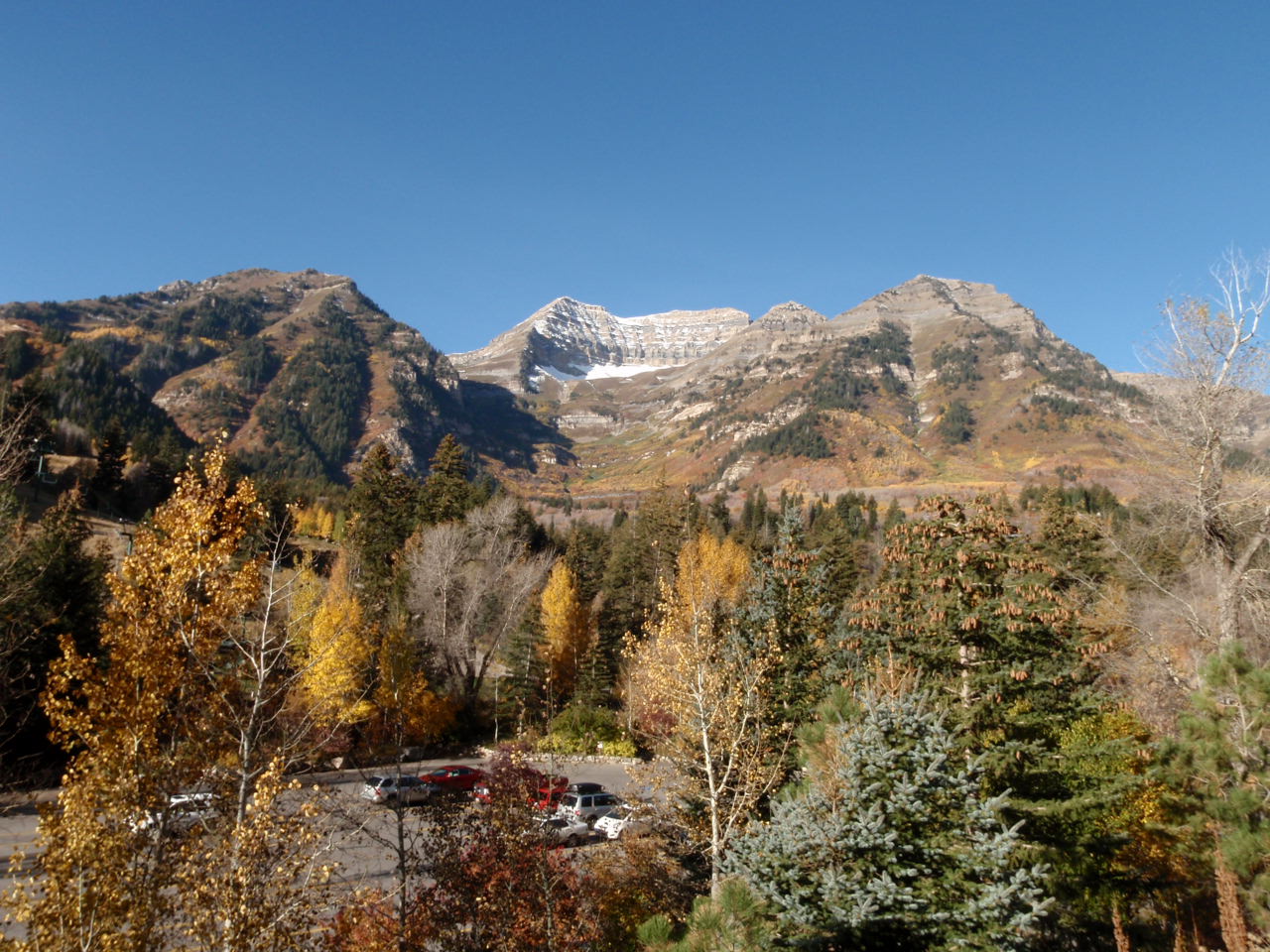
One of the more insane things I did in 2011 was biking all the way around Mt. Timpanogos in late November. It was something like 35 miles and 8,000 feet in total elevation gain. Only the first few miles were on road. Honestly, I don't think I'll ever do it again because, well, there are more fun long rides. It was epic and it was brutal. The photos below are in order. They show the mountain from the road on the way up (east side). We rode around the north side and then all along the west face. We had gorgeous weather and there were still leaves on some of the trees. Then we dropped down the southwest face back to our starting point on the south side, with one last photo of the beastly mountain we had conquered! Now I've been on top of it and around it. I declare victory and quit!




Sunday, January 8, 2012
Eternity and Exaltation
My lesson in high priests quorum the week before Christmas was on exaltation. The promises of exaltation have mystified me for some time. D&C 132:19 promises "thrones, kingdoms, principalities, and powers, dominions." As one quorum member observed, it sounds like a lot of work, and as another observed, these rewards are not very motivating. In fact, I had started the lesson asking each quorum member in turn what they valued, before they knew what the lesson was about. No one valued ruling others, which is the essence of the blessings, at first glance. After all, as I suggested, who wants the United States and its headaches, let alone a place like Afghanistan.
We puzzled on this a while. Obviously, countries are not what is promised, but I suppose worlds might be, and those are pretty similar. But as we talked about it, I began to realize, thanks to the comments of others, that this scripture must tie in with D&C 121:41-46. In these verses, we are told that if we live righteously, we will influence others for good. Perhaps the promise of exaltation, then, is that we will live so well that others will want to be like us and will improve their own lives as a result.
This is an amazing blessing! I think of all the times that I make imperfect judgments, that I hurt (or at least fail to lift) others through misplaced words or ill-considered actions, or that I am too slothful or short-sighted to see the needs of others and how to aid them. If I can rid myself of these imperfections and instead influence others for good, without compulsion, just by example, then, yes, this is something that is motivating and worth lots of work.
The scriptures also talk about priesthood power being used to move mountains or rivers. I think mastery of elements must come along with the sort of righteousness necessary to achieve exaltation. Such mastery is also motivational to me, but for more prideful reasons. I just think it would be really cool to manipulate elements to see what is possible.
In the end, all of this ties into the idea that the glory of God is intelligence. Exaltation must therefore be about perfect intelligence: an ability to fully understand people and nature, their makeup and trajectory. As a social scientist keenly aware of our limitations in understanding and predicting human behavior, such a state of affairs does indeed seem heavenly. As a human being who marvels at nature and who takes deep satisfaction from the shape of ice in a stream and the color of a flower, it is doubly awesome. I can really place my hope in such a vision of heaven.
We puzzled on this a while. Obviously, countries are not what is promised, but I suppose worlds might be, and those are pretty similar. But as we talked about it, I began to realize, thanks to the comments of others, that this scripture must tie in with D&C 121:41-46. In these verses, we are told that if we live righteously, we will influence others for good. Perhaps the promise of exaltation, then, is that we will live so well that others will want to be like us and will improve their own lives as a result.
This is an amazing blessing! I think of all the times that I make imperfect judgments, that I hurt (or at least fail to lift) others through misplaced words or ill-considered actions, or that I am too slothful or short-sighted to see the needs of others and how to aid them. If I can rid myself of these imperfections and instead influence others for good, without compulsion, just by example, then, yes, this is something that is motivating and worth lots of work.
The scriptures also talk about priesthood power being used to move mountains or rivers. I think mastery of elements must come along with the sort of righteousness necessary to achieve exaltation. Such mastery is also motivational to me, but for more prideful reasons. I just think it would be really cool to manipulate elements to see what is possible.
In the end, all of this ties into the idea that the glory of God is intelligence. Exaltation must therefore be about perfect intelligence: an ability to fully understand people and nature, their makeup and trajectory. As a social scientist keenly aware of our limitations in understanding and predicting human behavior, such a state of affairs does indeed seem heavenly. As a human being who marvels at nature and who takes deep satisfaction from the shape of ice in a stream and the color of a flower, it is doubly awesome. I can really place my hope in such a vision of heaven.
Sunday, January 1, 2012
Chilling over the Holidays
Well, this is the first time in a long while that I’ve bought a technological gizmo in its first month or two of release. For Christmas we got two new Kindle Fires. I’ve been hearing about apps and games like Angry Birds forever, but until now had never actually played any such game or used any apps. It turns out the Fires are pretty fun toys. The games are pretty entertaining. I think Cut the Rope is especially clever. Ellen loves sitting in bed watching episodes of TV shows, her latest love being Downton Abbey. I like checking my sports teams without having to kick someone off a computer. I’m also enjoying reading news and analysis from various sites as compiled by Pulse.
I really miss reading a newspaper or news magazine regularly. I need to make more time for that. I used to read the NY Times pretty regularly, but haven’t since I’ve been department chair. I still enjoy the Times when I catch glimpses of it, but would also like to branch out a bit to the Economist, the New Yorker, the Atlantic and perhaps others. I’m not much of a blog person. I try out blog sites from time to time, but usually find the analysis pretty superficial, and often referring to some more in-depth story published in one of these sources or something like them.
I really miss reading a newspaper or news magazine regularly. I need to make more time for that. I used to read the NY Times pretty regularly, but haven’t since I’ve been department chair. I still enjoy the Times when I catch glimpses of it, but would also like to branch out a bit to the Economist, the New Yorker, the Atlantic and perhaps others. I’m not much of a blog person. I try out blog sites from time to time, but usually find the analysis pretty superficial, and often referring to some more in-depth story published in one of these sources or something like them.
Sunday, December 18, 2011
Orderville Canyon
Charlie, Nathan and I hiked Orderville Canyon on Labor Day. The trees grow in amazing ways in the sandstone and some of the rocks are really interesting. As you descend the canyon, springs crop up frequently and water starts to run down the bottom of the canyon, feeding beautiful wildflowers. There are maybe a dozen short dropoffs that required climbing or jumping down, often into pools of water at the bottom. A couple required ropes as handlines. All were tons of fun, as each presented a different challenge in order to get down. The water wasn't too cold, though the day was none too warm. All of the dropoffs were gorgeous!


Sunday, December 11, 2011
Mt. Nebo Hike

 I've had lots of adventures this fall, but have been too busy recovering from them to blog about them! So, we finally have enough cold and snow to shut down mountain biking and not enough to ramp up snow sports. Plus Charlie went to Japan this week, leaving me a lone man.
 One of my favorite adventures this fall was hiking Mt. Nebo in mid-October. Mt. Nebo is the highest peak in the Wasatch Mountains, at nearly 12,000 feet.
Here are Charlie and me early on in the hike. We had picture perfect weather. The first snow of the season had dusted the summit the previous day, but the day was warm and inviting, perfect October weather.

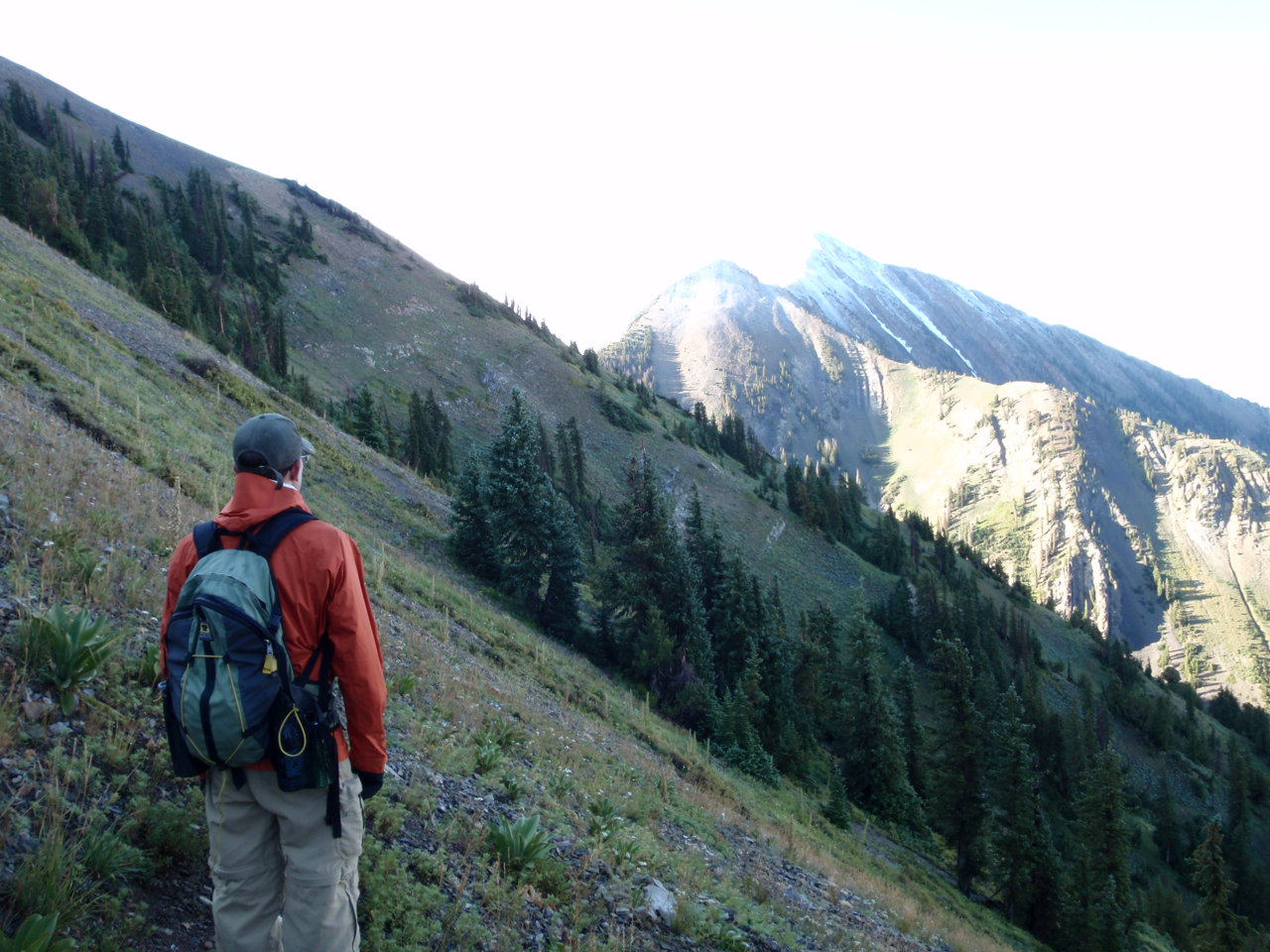

This is our first: "Whaaaaat? We're hiking that?" moment!


Charlie has that moment too.
Heading toward Wolf Pass, a gorgeous meadow at the shoulder of Nebo and North Peak. We hiked North Peak, another 11,000-foot peak, on the way back. The trail takes you within a couple hundred-foot scramble of the summit.
Wolf Pass looking up the trail toward Nebo summit. This is the trail to the northernmost and the highest of the three Nebo peaks. The trail doesn't look nearly as daunting up this close.
We had clouds on the east and clear weather on the west. It looked like the end of the world as you approached the dropoff!
The ridge taking us to Nebo. A light dusting of snow added a bit of slipperiness but not much.
The dogs LOVE the snow!
The late summer kept the flowers blooming at 11,000 feet, making a pretty sight in the first snow of the year.
The dogs on the summit. A little two-seater plane buzzed us and waggled its wings at us just 100 feet away. It was trippy to be as high as an airplane and a little higher as it dipped down!
Me on the summit looking north.
Me on the summit looking south!

Sunday, December 4, 2011
The Festival of Trees
We went to the Festival of the Trees yesterday. I think that’s the first time I’ve been since I was a kid. People donate and buy trees for Primary Children’s Hospital. Only it turns out that people also donate and buy a bunch of stuff surrounding the tree, which can amount to several thousand dollars worth of stuff, like sports memorabilia, digital pianos, ski passes, etc. It was quite a spectacle. I was rather taken in by it all despite the fact that it wasn’t really my cup of tea. Some of the trees and surrounding spreads were decorated in ways that seemed to say a lot about the person in whose memory they were created. There were some outdoorsy trees and superhero trees and sports trees to compete with the more traditional trees and female-oriented trees. I most enjoyed seeing photos of people in whose names the trees were dedicated. It presented the best and worst of Christmas: a charitable cause, giving, and memory of loved ones combined with spectacle, material goods, and glitz. It would be nice to have one without the other, but it seems there must needs be opposition in all things. Then in the middle of it all, I was arrested by one display. It had a rudimentary carpenter’s table with a simple sign: The Touch of the Master’s Hand. I had almost forgotten what Christmas was all about. It IS about giving and family, for sure. But it seems impossible for us as humans to have that without also having the materialism. The only way to overcome our all too human tendency to be attracted by this world is by combining our charitable impulses with Jesus. Charity without centering it in Christ can too easily get off track. It becomes generosity rather than charity. Generosity is certainly praiseworthy, and the Festival is laudable in so many ways. Yet it was much more meaningful once I remembered Jesus and the simplicity of His way.
Sunday, November 27, 2011
Ode To Thanksgiving
It’s Thanksgiving Weekend. My favorite holiday. I love Thanksgiving because it offers a lengthy break at just the right point in the semester. I love Thanksgiving because it has not yet been commercialized, and perhaps never will be, since it is simply enveloped by Christmas’ commercialization. It is the internet before all the ads: lovely, uncluttered, a place to connect in unhurried, simple fashion, without harassment. Thanksgiving is family, friends and food. It is playing games, hanging out, going on bike rides, reading a good book, or playing some football.
Sunday, November 20, 2011
Great Books My English Teachers Overlooked
Last week, I re-evaluated some of the classics I read in High School. They did not fare well, generally. This week, I highlight a few I missed in school that are definitely worth reading. They generally fare better. The themes are adventure and horror, a new genre for me.
Treasure Island: Great, rollicking adventure. Wonderful story for middle schoolers. Nathan liked it only OK despite the non-stop action, probably because the language is dated and the sentences are complex. I think it's the sort of story that can challenge kids his age but still reward them. There is a reason Long John Silver's name is widely known; he is one of the most memorable characters I've ever read about. He slips between good and evil as well as any double agent.
Last of the Mohicans: It's also a great adventure yarn with some military battles and history thrown in. I definitely see its attractiveness and staying power. Some of the scenes it describes are quite violent and often unexpectedly so. With the 19th-century language, one expects more Victorian sensibilities at times. Descriptions of the American wilderness are perhaps unmatched in anything I've read.
Dr. Jeckel and Mr. Hyde: A wonderful short novel, one that also strikes me as a great choice for middle schoolers or a bit older. The character's internal struggle against evil is rightly celebrated. Stevenson seems to capture well the nature of temptation and addiction's ghastly hold. The character's collapse and the inability of anyone to do anything about it are haunting and memorable.
Dracula: Somewhat disappointing. It is overly long and filled with too many Victorian niceties that sound rather ridiculous to the modern ear. I read an unabridged version; I think an abridged version would be just the ticket. In the unabridged version, the action gets bogged down in too much suffocating dialogue about how dear everyone is to everyone else and what large sacrifices they're all making for each other with their pure love. Any momentary stumbles in their perfect manners are quickly remedied by even more perfect kindnesses and soothing words of various sorts. Bluch. And it's not just that I need action; I generally love dialogue. The action, when it happens, is wonderful.
The Turn of the Screw: A brilliant evocation of possible madness, involving unresolved questions about what is real, and children in peril from both those who care too little and those who care too much. It is extremely well written.
Subscribe to:
Posts (Atom)